Vegel, A. & Hill, R. (2024). Small talk strategies card game for English language learners: Development and future directions
Metadata
- Author: Anton Vegel, Richard Hill
- Reviewed by: Fred Poole, Jules Buendgens-Kosten
- Volume and page numbers: 6 (p. 44 – 65)
- Date of publication: 2024/06/25
- Keywords: Communicative competence, Game affordances, Game development, GBLT, Interaction, Playtesting, Small talk, Spontaneously spoken speech
- Cite: Vegel, A. & Hill, R. (2024). Small talk strategies card game for English language learners: Development and future directions. Ludic Language Pedagogy, 6, 44-65. https://doi.org/10.55853/llp_v6Ar1
Download
Compendium materials
Anton and Richard have made their game available as a free downloadable resource. Please check the following website: https://sites.google.com/view/smalltalkcardgame/small-talk-strategies-card-game.
Key Points
- Background: EFL contexts require instructors to create opportunities for natural or improvised communication which can reflect ‘real world’ conversations.
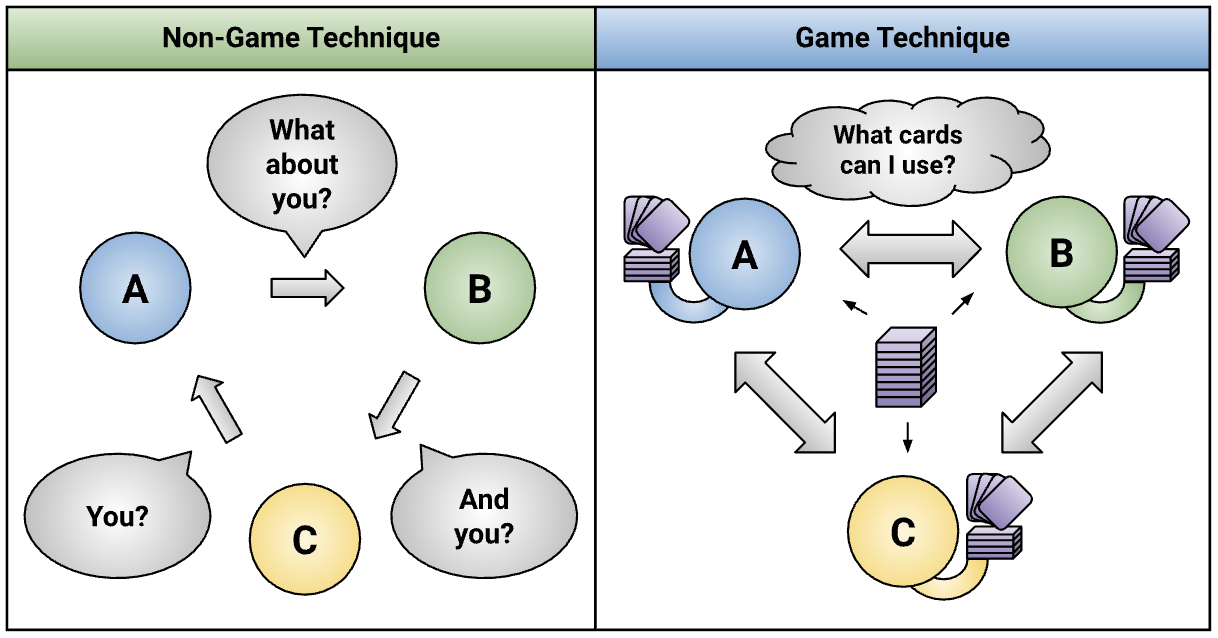
- Aim: We aimed to improve on a small talk strategies non-game technique with a game-based technique for EFL contexts.
- Methods: We developed and deployed a game-based technique using a playtesting approach.
- Results: Positive findings (game affordances and pedagogical potential) are preliminary and descriptive in nature. Interaction constructs are proposed to guide future research.
- Conclusion: Small talk strategies practice with a game-based technique shows promising pedagogical potential, but further verification is required.